Monday, October 13, 2014

A Quirky Championship!

Wife Carrying Championship: A championship which makes a man value his wife's weight!!

This is unique sport which originated in Finland and basically is a contest where a husband carries his wife through an obstacle course. The couple who completes the obstacle track in the shortest time, wins.

The husbands are allowed to carry their wives only in a few ways. These ways are:
1. piggyback
2.  fireman's carry (over the shoulder), or 
3. Estonia style (the wife hangs upside-down with her legs around the husband's shoulders, holding onto his waist).
In Finland these compitions are held every year and the winners prize is beer . It doesnt just end there.. the quantity of beer given away varies according to the wife's weight. Therefore if a guy has a big wife and wins the race...it means more beer!
The competition today, is held in a number of countries.

The story behind the origins of this completion dates back to the 1800 's in Finland. A robber named Herkko Rosvo-Ronkainen lived in a forest with his gang of thieves. He and his gang of thieves stole food and women from villages. They kidnapped women and ran away from the village with the woman on their backs. This wife stealing act eventually became an annual and much loved competition.


Interestingly, an International Wife Carrying Competition Rules Committee has been set up. This committee has set up the rules to standardise the competition taking place in different parts of the world. Some of the rules worth noting are:
  • A defined length of the  track (253.5 meters) which has to have atleast 2 dry obstacles and one water obstacle.
  • The wife to be carried may be your own, or the neighbor's, or you may have found her further afield; she must, however, be over 17 years of age :)
  • The minimum weight of the wife to be carried is 49 kilograms. If she weighs less than 49 kg, she will be burdened with a rucksack containing additional weight to bring the total load to be carried up to 49 kg :)

So if the competition was to happen in your city , would you participate ??? :)

Saturday, October 11, 2014

Polio Program in India: A Historic and Path Breaking Campaign

Poliomyelitis often called polio or infantile paralysis, is a disease caused by a the spread from person to person of the polio virus. 
Most patients suffering from polio dont have any symptoms however in about  1% of cases, the virus enters the central nervous system leading to muscle weakness and acute flaccid paralysis which most often involves the legs. The legs of the affected person are paralysed for life.
Government of India launched the Pulse Polio programme, an immunization campaign which deals with vaccinating all children under age of 5 years against polio virus,   to eradicate polio in India. The programme started in India in 1978 and the last polio case was seen in 2011. In 2012, India was removed from the list of polio endemic nations and in 2014 , India was declared polio free. This is a big feat for a developing nation like India which has a population of over 1 billion people.
The success story of polio eradication is a story of innovation,  perseverance, dedication, commitment and partnership.  This programme has been successful due to participation of both the civil society and the government.

This project deals with the ways to fight poliomyelitis through a large scale immunisation programme, co-operating with various international institutions, state governments and Non Governmental Organisations, as part of the Global Polio Eradication Initiative, spearheaded by Rotary International, the World Health Organization, UNICEF, and the U.S. Centers for Disease Control and Prevention.

Major Success Factors are:
1. Strong, political and financial commitments
2. Meticulous planning, execution and monitoring
3. Generation of high quality data and objective evidence
4. Ongoing tactical and scientific innovations based on data analysis and research
5. Perseverance and resilience to overcome the range of challenges
6. Strong, enduring, effective partnership.

The programme required detailed microlevel planning such as house to house vaccination, tools to collect data child vaccination of every household ,putting a mark on every vaccinated childs finger in  order to identify unvaccinated children, putting a mark on every house in which children remain unvaccinated. In a population of over one billion people this was a tedious task but through combined efforts it was accomplished.

Two major challenges which have been seen and tackled during the programme are (1) failure to vaccinate (2) vaccine failure

The first challenge i.e., failure to vaccinate was tackled by massive human resource development for community mobilizations, reaching out to community leaders etc.

For example, the Kosi river belt in India is an area which constantly experiences heavy floods thereby making the area inaccessible. Thus it was a challenge to eliminate polio from this area and 10-15%  children were always missed during campaigns. This area was identified during surveillance programmes and a multipronged approached was taken to achieve high coverage in this area.

The second challenge i.e., vaccine failure was tackled by observing response to the three available vaccines i.e., monovalent, bivalent and trivalent. On realising that bivalent vaccine was most effective, this vaccine was used to achieve high elimination rates.

Many such road blocks were tackled effectively and timely to make india completely polio free. The last case of a polio patient a young girl called Ruksana was seen in 2011. Since 2011, no news cases have been detected however surveillance continues as unless polio is eradicated around the world , possibility of eliminating the virus from India completely is  distant possibility.

The success story of polio programme in India sets an example for the other countries which have not been able to root out polio completely. It is a testament that much can be achieved by concerted efforts of both thd civil society and thd government.

Thursday, October 2, 2014

Season of festivities: Dusshera

The beginning of autumn fills the air with so many reasons to cheer about! Along with great weather, these are many festivals lined up in the month of October to December. As a winter chill sets in here in northern India, a relief from the scorching summers the festivities begin with the celebration of the Dusshera festival.

Dusshera also known as Vijayadashami celebrates the victory of of good over evil as described in hindu religious texts where Lord Rama defeated the demon king Ravana and Goddess Durga defeated the demon Mahishasur.
Effigies of 10 headed demon king, Ravana
As the legend goes, King Rama who was a reincarnation of hindu God, Lord Vishnu, killed the great demon Ravana who had abducted his wife Sita and taken her to his kingdom, Lanka. Rama took blessings from Goddess Durga and along with his brother Lakshmana, his follower Hanuman and an army of monkeys fought a  battle defeat Ravana and  rescue Sita. 

Dusshera is celebrated by burning effigies of the 10 headed demon king Ravana and his accomplices and bursting of crackers.

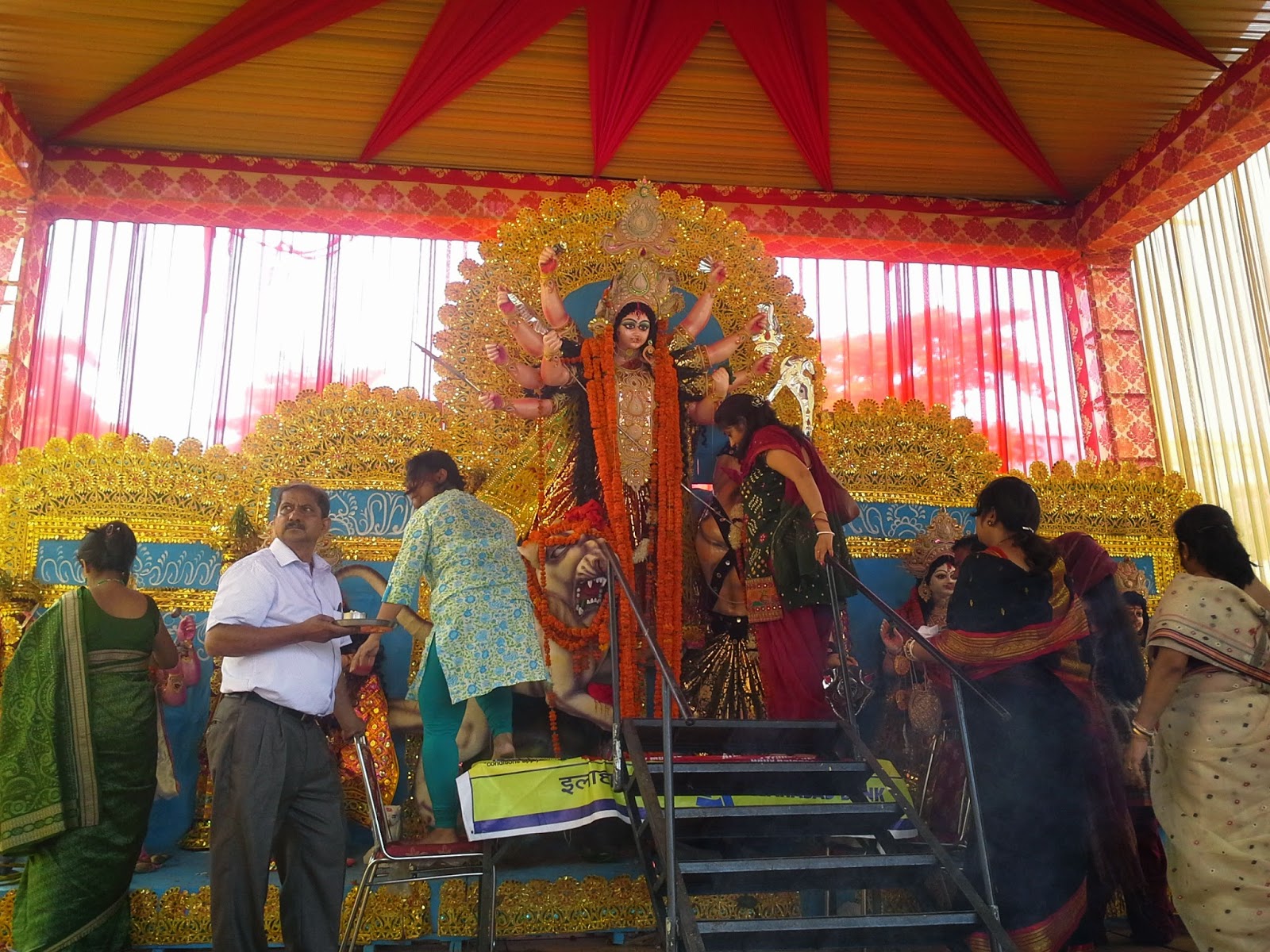
As per another legend some of the demons, were very powerful and ambitious and continually tried to defeat the Devas, or Gods, and capture Heaven. One such poweful demon Mahishasur defeated the Devas and wreaked havoc on eargh. To overcome and defeat this demon, the devas joined forces and released a single mass of incandescent energy called Shakti to kill Mahishasura. This shakti emerged in the form of a young, beautiful female with ten hands, known as Goddess Durga. All the Gods gave their special weapons to her. In a battle that went on for 9 days Goddess Durga , riding on a lion, fought Mahishasur and finally defeated him on the 10th day. 
A idol of Goddess Durga, showing her ten hands , the lion she rode and the demon Mahishasur she defeated


Hence the nine days preceeding Dusshera are known as Maha Navratri refering to the nine days during which Goddess Durga fiercely fought Mahishasur. Hindus often observe fast on all of these nine days and offer prayers to the Goddess.


Wednesday, October 1, 2014

River Banks and Bridges of Budapest

The beautiful capital city of Hungary,  Budapest is built around the majestic Danube river. It is not only the largest city of Hungary but one of the biggest cities in the whole of Europe. The numerous historical monuments and abundant sightseeing spots in Budapest make it a haven for tourists.

While describing my trip to the city, I have to begin with the boat cruise that I took on the Danube river because without doubt it was the highlight of my touristy journey around the city.

Danube runs through the centre of  Budapest dividing it  into two regions i.e.,  Buda and Pest.  There are many bridges linking both the parts of the city. The beauty of these bridges is that each of has been given a special name and varies in its construction style. Over 10 bridges link east and west of Budapest. Each of these bridges are an architectural marvel but of note are the Chain bridge,  Elizabeth bridge, Liberty bridge, Megyeri bridge and Margaret bridge. It was interesting to learn the history behind each of these architectural marvels.

Chain bridge was the first bridge to be built across Danube. It is a suspension bridge and lion structures adorn it. It was built by an english architect William Clark in 1839 and was opened to public 10 years later.

Elisabeth bridge, named after a popular queen of Austri- Hungary, goes through the narrowest part of Danube and is the most elegant bridge of Budapest. It was built in 1894 and unfortunate as it is, the queen died just a couple of years after the bridge was constructed.


Margaret Bridge

This bridge was built by a French architect and  it is the second oldest bridge in Budapest. The bridge leads up to Margaret island which lies in the center of Danube and is a popular tourist spot for its landscape parks.

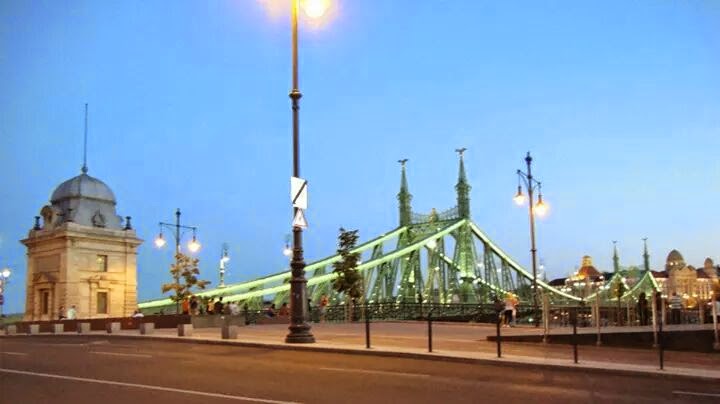
Liberty bridge
This beautiful green bridge has large bronze statues of the Turul, a falcon-like bird, prominent in ancient Hungarian mythology on its  four masts. The bridge was built between 1894 and 1896. 

Megyeri bridge is one of the newly made bridges and circles the entire city.

These multiple links keep the city connected and are important landmarks of the city.  An interesting fact about these bridges is that most of these structures were blown up 
/destroyed during world war II and had to be reconstructed.

During a night cruise  on the Danube the bridges are beautifully lit and look divine. Other beautiful buildings on the banks are are also well lit and make the cruise an exceptional experience.
Photos to support my claims :)
Birds eyeview of Budapest city


Parliament On  the banks of river Danube

Buda Castle

Fishermans bastion on the banks of river Danube

Friday, September 19, 2014

Bindi : the Indian symbol of third eye

In India, it's tradition for women to wear a bindi. A bindi is a mark, generally circular,  made on the center of the forhead.

The dot is commonly placed slightly above the junction of the eye brows as this area represents the seat  of concealed wisdom. Wearing a bindi on that area is said to strengthen concentration and retain energy. Also, this area is considered to be the seat of the third eye. The third eye as per Indian spiritual texts is the inner or invisible eye which can give you perception beyond ordinary sight. It is thought to be the gate to higher consciousness. Therefore people who meditate generally fix their gaze at this spot.


Generally the mark is made in red as it represents the colour of love, honour and prosperity.

In ancient times, the bindi represented a sign of worshipping ones own intellect therefore it was worn by both men and women.

A strong intellect was thought to help one to make noble decisions in life, to be able to stand up to challenges in life with courage, and to recognise and welcome good thoughts in life. 

In some parts of india a red dot on the forehead is made to signify the married status of the woman and is a sign of respect for the institution of marriage. 

Over the years , the bindi might have lost its religious importance but it is worn very frequently with the Indian traditional dresses such as the Sari to cosmetically enhance the look.

Tuesday, September 16, 2014

Plitvice National Park, Croatia

So I was headed towards Croatia on my Euro holiday. The destinition was Zagreb , the capital city of Croatia. Unlike the seamless crossing into different countries in Europe with the Shenzen Visa, I was surprised when at the Croatian border my visa went under the scanner. The reason for this was that Croatia at that time was not a part of European Union (Croatia became the 28th country to join the European Union in July 2013).

Honestly, I was unimpressed with Zagreb. Having already travelled to more economically well to do countries in Europe,  I had seen plush cities. Zagreb in comparison didn't have anything impressive to offer or so I felt.

However, after a tour around the capital,  I headed towards the outskirts of the city. I was pleasantly surprised to see that only at a short distance away (2 hours by road) from the capital city an exquisitely beautiful national park was nestled in the woods.

Plitvice National park is situated close to the border to Bosnia and Herzegovina and is a UNESCO World heritage site.


What's sets this national park aside are the 16 beautiful lakes nestled in the park. The lakes are arranged in cascades and are formed by confluence of numerous small little rivers .

Plitvice is the oldest national park in South East Europe.The lakes are known for their distinctive colors, ranging from azure to green, grey or blue. The colors change constantly depending on the quantity of minerals or organisms in the water and the angle of sunlight.


A beautiful cobbled stoned path has been built all along the banks of the lakes , making it easy to access these exotic water bodies.


 Number of lodges /hotels offer accomodation around this area and the lakes are just a few minutes trek down from these places.

The serenity of the place and the beauty of the lakes is just larger than  life and it's a humbling experience to be amongst such abundance of natural beauty.

And finally a happy feet photo to end my write up :)

Saturday, September 13, 2014

India's beautiful valley in strife!

India's beautiful valley of Kashmir has been in strife for a long time now. Almost a 100 years before India got its independence from British raj in the year 1947, the autonomous princely state of Jammu and Kashmir was created.  At that time, although this state was a Muslim dominated state, it's ruler Gulab Singh was a hindu.


He was succeeded by Maharaja Hari Singh who belonged to the Hindu Dogra dynasty and was considered to be partial to the Muslim population and largely kept them illiterate, poor and feebly represented in the state assembly. The unrest among the people of the state grew but their attempts at revolt were brutally crushed by the state forces. However the rebellion to end the autocratic rule grew continously and following Indian independence the ruler of Jammu and Kashmir acceded the state to India.


Pakistan did not accepted this accession and the first war between India and Pakistan took place in 1947-1948. Since then the region has been in conflict with Indian authorities trying to maintain peace while insurgents and militancy trying to create unrest.

With public sentiment flying high in the region a number of hindu settlers of the region had to flee fearing for their lives.

Due to the ongoing unrest in the region, development, industrialization, tourism have taken a hit. I for one have not visited the region as for long as I remember it was not safe to be there but people who have had the good fortune to be there in more peaceful times cannot stop raving about the beauty of the valley. It a shame that a resolution had not been reached in over so many years and people suffer!

This year the region saw another problem crop up and this time it was not man made. The worst ever floods in Kashmir' s history ravaged the region. Near about 500 people lost their lives and a number of villages were completely washed away forcing nearly 700,000 people to leave their homes.

The suffering continues... It is as if God is raging his fury at the man made conflict and stubburness of humans..Prayers for the people in the valley.

I made my contribution towards the relief fund , so can you. Every bit is useful..
Link is mentioned below..donation towards relief fund

Friday, September 12, 2014

Could travel on a long distance flight kill you ?

And I am not refering to plane crashes, tecnical glitches and bird hits! The chances are low however, it is a possibility that a travelling on a long distance flight or for that matter any other travel where mobility is restricted may lead to a medical condition called 'Deep Vein Thrombosis' which can be life threatening at times!


 Conditions which restrict mobility can lead to stasis of blood in veins and can cause blood to clot. The blood clot is called a 'thrombus'. It generally affects the veins of the legs and the signs are swelling of the limb, pain and redness over the affected area. 


 So how can this condition be life threatening? As long as the clot is in the leg it is not serious however at times, a piece of the clot can dislodge and move up to the arteries of the Lung. This can be life threatening and is called 'Pulmonary Embolism'! Fortunately the condition can be diagnosed and treated. 


Diagnosis is generally done by administering dye into blood of veins and then seeing the blood flow obstruction through imaging or by ultrasonography (which is identifying the block in the veins by using ultrasound waves). A number of medicines are available to treat this condition such as heparins, warfarin etc.


 Other conditions which can cause 'Deep Vein Thrombosis' are : 

1. Post surgery - where mobility of the patient is restricted for days.
 2. Bedridden patients in nursing homes
 3. Age greater than 75 years 
4. Cancer 

 So next time you take a transatlantic flight and your leg starts to pain , do not take it lightly.


Tuesday, September 2, 2014

Amendment of Indian criminal law on sexual offences

In December of 2012, India witnessed one of the most horrific of rape cases in its history in its capital city, Delhi.

The public was outraged and much was said about the ineffectiveness of the security forces and need for stricter laws to help prevent such incidences. Thus, in 2013 the Criminal Law (Amendment) Act, on laws related to sexual offences took place. In order to assuage public unrest, this amendment took place in a rush.


The most important change that has been made is the change in definition of rape under Indian Penal Code.. The section has been amended to include "penetration to any extent", and has made "lack of physical resistance" as an immaterial evidence for constituting an offence. Except in certain aggravated situation the punishment is imprisonment not less than seven years but which may extend to imprisonment for life, and shall also be liable to fine. 


Although the intent of this amendment was to ensure that stricter punishments would act as a deterrent for anyone with malicious ideas and no doubt that it has been able to achieve that however it cannot be overlooked that misuse of this law has also increased. For relationships which fail, women are using this law to forcefully get marital rights and earlier consensual acts are being termed as 'rape' when things don't turn out as planned. The  bizarre thing about all these rape accusations is that the victim wants to get married to the man she says raped her thereby making a mockery of the law and undermining it. Does getting into marriage with a man who has betrayed you guarantee hapiness? As soon as the man agrees on marriage, the charges are dropped. I feel this is really sad and should not be allowed. If a man is considered to have committed a crime then the case should be fought to convict him and to see that he serves the sentence. 

This sort of manipulation of the law just undermines the case for all genuine cases of rape. Maybe a further amendment of the law is required.


Lifestyle Changes to Control Hypertension

Hypertension or high blood pressure is a common illness  which if left untreated can cause complications like heart attack, stroke, renal failure.

The 7th report of the Joint National Committee by Heart, Lung, Blood intitute , Maryland, USA in 2003 are widely  followed guidelines on Prevention, Detection, Evaluation and Treatment of hypertension.


As per the JNC 7 guidelines , the salient points are as follows:

  • Stages of hypertension:
    1.  Systolic Blood Pressure (SBP) lesser than 120 and Diastolic Blood Pressure (DBP) lesser than 80: optimal blood pressure
    2. SBP greater than 120 but lesser than 139 and DBP greater than  80 but lesser than 90: Prehypertension (boderline)
    3. SBP greater than 140 but lesser than 159  and DBP greater than 90 but lesser than 100: First Stage  of Hypertension
    4. SBP greater than 160; DBP greater than 100 : Second Stage of hypertension


  • Risk factors or factors which promote the propensity of a person to develop hypertension are:
         - increased weight
         - decreased physical activity,
         - less vegetables and fruits in diet,
         - excess dietary sodium intake and 
         - decreased intake of potassium,  
         - increased intake of alcohol.

It is important to keep blood pressure in control and a few lifestyle changes which can make a huge difference in that respect are as follows:

1. Lose weight
It has been seen that every 1% reduction in weight can decrease blood pressure by one unit. Therefore a weight loss of 10 kg can reduce blood pressure by 6-10 units (mm of hg)

2. Decrease salt in diet

  • Salt has high sodium content which should be avoided in  hypertensive patients.  Sodium is a mineral in blood.
  • There are tests available to test levels of sodium in blood.
  • Therefore it's best to choose plant based food or packaged food which clearly states 'low sodium' or ' no added salt'
3. Build in an exercise routine
Thirty(30) minutes of moderate intensity workout on most if not all days of a week is recommended.

4. Increase potassium rich food in diet
  • Potassium is a mineral in blood
  • There are tests available which can test the amounts of potassium in your blood.
  • Foods rich in potassium are  meats, beans, tomatoes, potatoes, and fruits such as bananas. 
5. Decrease alcohol intake
A man should not exceed 2 standard drinks/day while a woman should not exceed 1 standard drink/day
Atleast 2 alcohol free days in a week should be practiced.